
Top 10 Myths About Gaming PCs come from a lot of assumptions. Some are half-true, some are outdated, and some are just wrong. If you’ve spent any time around gaming hardware, you’ve probably heard most of these before — usually said with way too much confidence. Let’s clear a few of them up.
Myth #1: Brand New IT Is Better Than Refurbished
Truth: Sometimes it is. A lot of the time, it isn’t.
People assume new IT is better because it feels safer. No one’s used it, no one’s stressed it, nothing weird’s happened to it yet. That logic makes sense on the surface.
And yes, new hardware does matter in some cases. If you’re running something critical, need full vendor warranties, or rely on the latest firmware and software, buying new is often the right move.
Where it goes wrong is when people assume refurbished means worse. Slower. Less reliable. That’s instinct talking, not evidence.
We tested this with the University of East London back in 2020. Same manufacturer, same model — new servers versus refurbished. CPU performance, RAM, storage, energy use. No difference. Same results across the board.
That’s not shocking if you’ve worked with enterprise hardware. Servers are built to run hard for years. They don’t wear out just because they’ve been switched on before.
If refurbished kit has been properly tested and validated, it performs exactly as it should.
So no, new isn’t automatically better. Sometimes it’s necessary. A lot of the time, it’s just more expensive.
Myth #2: It’s Safer To Store Data On-premise Than In The Cloud
Truth: In a lot of cases, the cloud is actually safer — even if it doesn’t feel like it.
This one usually comes from a gut reaction. If your data is sitting in a server room inside your building, it feels like you’re in control. You can see it. You know where it is. You can point at it and say, “That’s our data.”
The cloud doesn’t feel like that. It feels vague. Distant. Like your files are floating around somewhere you can’t quite picture. And that makes people nervous.
But security doesn’t really care how something feels.
Most reputable cloud providers run enterprise-level infrastructure that’s on a completely different scale to what most organisations can realistically build themselves. Their data centres have physical security, constant monitoring, encryption, redundancy, disaster recovery, and teams of people whose full-time job is just security.
Compare that to a lot of on-premise setups. A small server room. Limited budgets. Patches that get delayed. Backups that might exist, but haven’t been tested in months. Maybe years.
There’s also the issue of location. If your on-premise data is stored in the same building you work in, what happens if there’s a flood? Or a fire? Or a power issue? Or even just a break-in?
Cloud data is usually stored across multiple locations, separate from your workplace entirely. That separation is actually a strength, not a weakness.
None of this means the cloud is magically secure by default. You still need proper configuration, access controls, and good practices. But the idea that on-premise is automatically safer than the cloud just doesn’t hold up anymore.
Also Read: Top 5 Myths About SSD vs HDD – 2026
Myth #3: It’s essential To Replace IT Hardware Every Year
Truth: For most organisations, that’s massive overkill.
Somewhere along the way, IT picked up this idea that hardware needs to be constantly replaced to stay “modern”. Every year. New cycle. New kit. New spend.
For the vast majority of businesses, that just isn’t necessary.
Unless you’ve got a very specific requirement — a new application that needs more resources, a compliance issue, or some kind of hardware dependency — most good-quality IT hardware can comfortably last three to five years. Sometimes longer.
If you’re buying from reputable manufacturers, this equipment is built for longevity. Servers, storage, and networking gear aren’t designed to be disposable. They’re meant to run, and keep running.
Replacing hardware too often doesn’t just cost more money. It creates disruption. It increases waste. It adds unnecessary complexity. And in a lot of cases, it doesn’t actually deliver much benefit.
That doesn’t mean “never upgrade”. It just means upgrading because there’s a reason, not because the calendar says so.
Myth #4: Common Sense Is As Good As Antivirus Software
Truth: Common sense helps, but it’s nowhere near enough.
People like to think they’re careful. They don’t click obvious scam links. They don’t download random files. They trust their instincts.
That’s all fine — and it does matter. Training users to be aware is important. But the problem is that modern cyber threats aren’t obvious anymore.
A lot of malware doesn’t look suspicious. A lot of phishing emails don’t scream “this is a scam”. They’re subtle. They’re well-written. They’re designed to trick people who do have common sense.
Antivirus software isn’t there because users are stupid. It’s there because humans can’t see everything. Good antivirus software constantly scans for malicious activity, blocks known threats, and reacts faster than a person ever could.
Think of it less like replacing common sense, and more like backing it up with something that doesn’t get tired or distracted.
If security relies entirely on people never making mistakes, it’s already failing.
Myth #5: It Is Safe To Open Any Attachment From Inside Your Company
Truth: Internal emails are often how attacks spread.

This is a dangerous one, because trust works against you here.
Phishing emails are very often designed to look like they come from someone you know. A colleague. A manager. A customer. Someone familiar. Sometimes they actually do come from a real internal account that’s already been compromised.
Once that happens, attackers use that trust to move fast. They send attachments. They share links. And because the sender looks legitimate, people open them without thinking twice.
“That came from finance, it must be fine.”
“That’s from my manager, I should open it.”
“That’s internal, it’s safe.”
Except sometimes it isn’t.
The safest approach is always to pause for a second. Were you expecting this? Does it make sense? Is the link going where it should?
And beyond that, having proper internet security software in place adds a crucial layer of protection. Because sooner or later, someone will click something they shouldn’t. That’s just reality.
Myth #6: Virus Protection Isn’t Necessary If You Don’t Have Sensitive Data
Truth: Attackers don’t care what files you personally have.
This myth usually comes from individual users thinking they’re not important. “I don’t have anything valuable on my laptop, so why would anyone target me?”
But attackers aren’t targeting you. They’re targeting the network.
If one employee’s device is compromised, that machine becomes a doorway. From there, attackers can move around, escalate access, and reach systems that do contain sensitive data.
An unprotected endpoint is still a risk, even if the user thinks their files don’t matter.
That’s why endpoint protection needs to be consistent. Not just for senior staff. Not just for people with “important” data. For everyone.
Also Read: Top 10 Myths About Laptop Performance – 2026
Myth #7: Adding RAM Speeds Up Your PC
Truth: Not exactly — but it can help in the right situation.
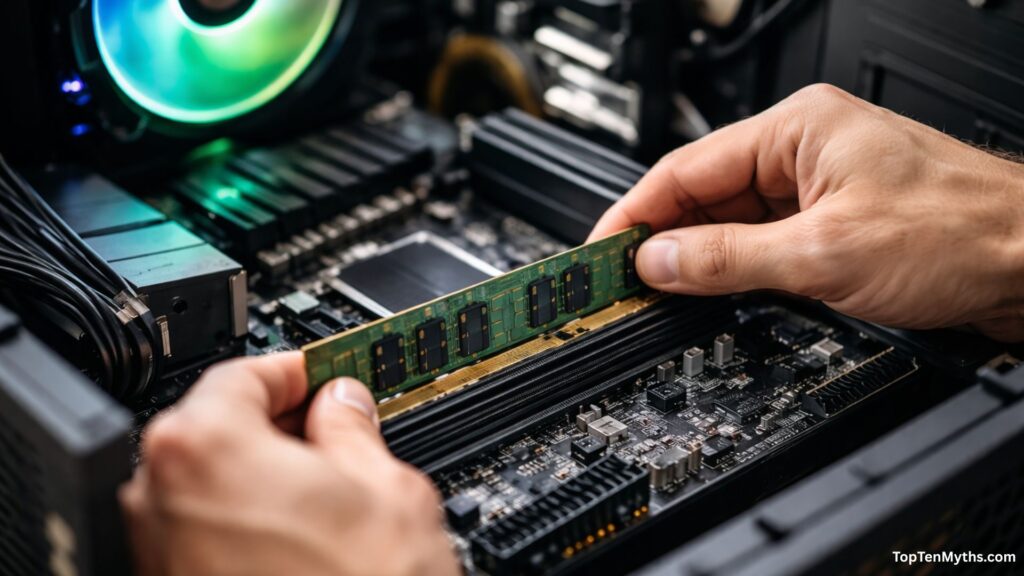
RAM doesn’t make your processor faster. It doesn’t magically improve everything. What it does is help your system cope when you’re doing a lot at once.
If your machine is constantly running out of memory, it starts leaning on slower storage instead. That’s when things feel sluggish. Apps freeze. Tabs lag. Everything just feels… heavy.
In those cases, adding more RAM — the right kind, in the right configuration — can absolutely improve performance. Especially on older machines that were under-spec’d to begin with.
So no, RAM isn’t a miracle fix. But it’s often one of the simplest, most cost-effective upgrades you can make when it is the bottleneck.
Myth #8: Computers Should Be Shut Down Every Night
Truth: Modern hardware can handle staying on — but there are still reasons to switch off.
This advice comes from a time when hardware was more fragile. Older drives and components didn’t cope as well with constant use, so shutting down regularly made sense.
Today’s equipment is much tougher. Leaving a machine on overnight generally isn’t harmful.
That said, running machines when they’re not being used still consumes energy. Over time, that adds up. Using sleep or power-saving modes is often a better balance.
Also, many important updates and security patches install during shutdowns and restarts. So while you don’t need to panic about leaving something on, regular restarts are still a good habit.
Myth #9: Deleting Contents From Your Hard Drive Actually Erases Them
Truth: Most of the time, it really doesn’t.

When you delete a file, your system usually just marks that space as available. The data itself stays there until something else overwrites it. Until then, it’s often recoverable.
That’s why simply deleting files or formatting a drive isn’t enough when equipment is being reused, redeployed, or disposed of. Without proper data sanitisation, old data can still be accessed.
Secure data erasure isn’t about convenience — it’s about protecting your organisation long after the hardware has left your hands.
Myth #10: IT Recycling Is The Most Sustainable IT Disposal Solution
Truth: Recycling is better than nothing, but it shouldn’t be the first option.
Recycling sounds good. And compared to landfill, it is. But even the best recycling processes can’t recover everything. There’s also an energy cost involved in breaking down hardware.
The most sustainable option usually comes before recycling.
Reuse, redeployment, repurposing, and refurbishment keep equipment in use for longer. That reduces e-waste, lowers demand for new manufacturing, and cuts the overall carbon footprint of IT hardware.
Recycling should be the last step — not the default.
Conclusion
Gaming PCs aren’t as complicated or fragile as people make them out to be. Most of the myths come from old advice that never got updated. Ignore the noise, focus on what actually affects performance, and you’ll be fine.
Frequently Asked Questions (FAQs)
Q. Are gaming PCs really that expensive?
Ans: Not always. They can be expensive, but they don’t have to be. A well-balanced build often costs less than people expect, especially if you’re not chasing top-tier parts.
Q. Do gaming PCs become outdated quickly?
Ans: Not really. Most gaming PCs last years with no issues. You can usually upgrade parts over time instead of replacing the whole system.
Q. Is building a gaming PC risky or complicated?
Ans: It looks intimidating, but it’s mostly plug-and-play these days. As long as parts are compatible and you take your time, it’s hard to mess up badly.
Q. Do you need the latest hardware to play new games?
Ans: No. Most games are designed to run on a wide range of systems. Ultra settings aren’t mandatory for a good experience.
Q. Are gaming PCs only for hardcore gamers?
Ans: Not at all. Plenty of people use gaming PCs for casual gaming, work, streaming, or creative tasks. They’re just versatile machines.