
While AI holds incredible potential, it’s also shrouded in misconceptions that range from the amusingly absurd to the dangerously misinformed. Some of these are shaped by the depiction of AI in movies and entertainment, while others are perpetuated by fear or lack of knowledge. In Top 10 Myths About AI and Human Creativity, we explore these misunderstandings in depth, drawing from our experience as builders of AI systems for businesses at Quantilus. We strive to educate organizations on the best utilization of AI by helping them grasp the realities of how it operates, its capabilities and limitations, and the indispensable role that human oversight plays in crafting effective and ethically responsible AI systems.
To this end, our team met to discuss myths we often run across and curated the top 10 we want to dispel so our prospects, clients, and the world can understand the reality. These myths not only affect perceptions but also impact decision-making processes within businesses. Through debunking these myths, we aim to empower businesses to harness the true potential of AI while dispelling any lingering misconceptions that may hinder progress. So, let’s dive into the 10 myths surrounding AI, shedding light on the truths that lie beneath the surface.
Myth #1: AI Is Sentient And Self-Aware
First off, no. AI does not have a mind of its own. There’s no little robot brain plotting away in the cloud somewhere. No consciousness. No self-awareness. Nada.
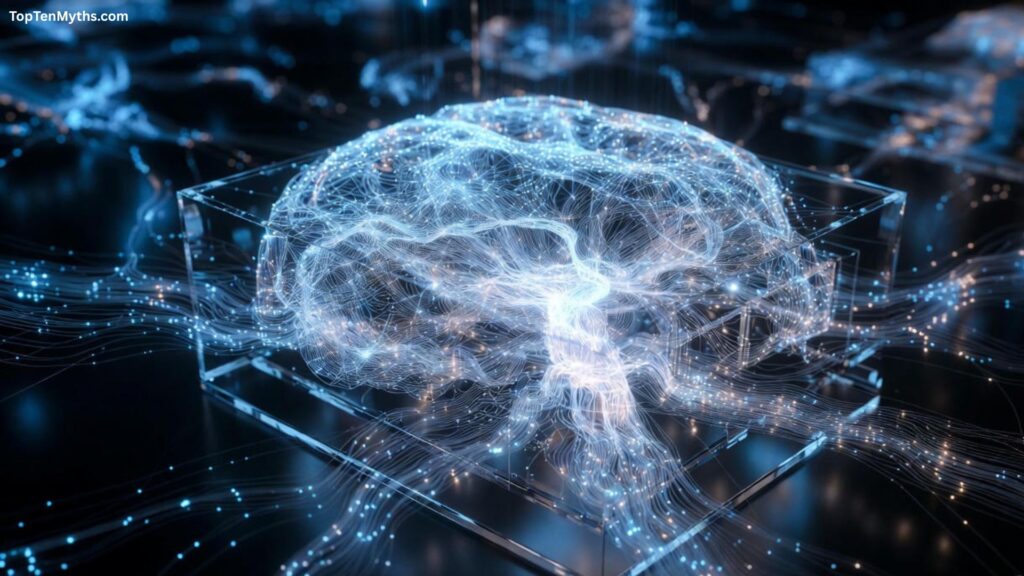
Movies make it seem like AI is sitting in a dark room, thinking deep thoughts about life, humans, and how to overthrow them. Reality? It’s more like a really, really fast and complicated spreadsheet. It takes data, follows rules, and produces output. That’s literally it.
Imagine a calculator. It can solve equations faster than you, but it doesn’t understand math, it just follows rules. AI is the same thing, just way more complicated. There’s no secret intelligence lurking somewhere.
Myth #2: AI Can Solve A Problem Without Understanding The Problem Itself
Nope, nope, nope. AI doesn’t “get” things the way we do. It’s super good at tasks it’s trained for, but if you ask it to go off script, it’s going to crash… metaphorically speaking.
For example, you can train an AI to detect cats in images. Feed it a dog picture? It’s confused. Put a meme with a cat? Probably confused too. Why? Because AI doesn’t understand concepts like humans. It just looks for patterns it’s seen before.
This is why people get frustrated with AI sometimes — they expect it to “think” like a person, but it’s really more like pattern-matching on steroids. Humans still have to set the problems, guide it, and interpret its output.
Myth #3: AI Understands Context Like Humans
Context is tricky. Humans are really good at it. You hear “I saw her duck” and you know if it’s a bird or if she crouched. AI? Not so much. It’s mostly just guessing based on probability.

This is where a lot of AI projects go off the rails. You can’t just dump AI in a complex situation and expect it to “get” everything. It’s great for structured problems — things with rules, patterns, data — but nuance? Forget it.
Which means humans aren’t optional. You still need someone in the loop to catch mistakes, interpret the situation, and sometimes just tell the AI, “Nope, that’s wrong.”
Also Read: Top 10 Myths About AI Being Dangerous 2026
Myth #4: AI Is Infallible
Stop thinking that. AI fails, sometimes spectacularly. And usually it’s because the data or rules it learned from were flawed. Bias, errors, missing info — all of it messes things up.
There are tons of examples online. Facial recognition algorithms? They fail more often with people of color. Language models? They can generate biased or offensive text. And it’s not like AI decided to be bad — it’s just copying patterns from humans.
So yeah, AI is impressive, but it’s not magical. Mistakes happen, and humans have to catch them. Always.
Myth #5: Once An AI System Is Built, It Can Run Itself
This is a classic. People think you just build it, plug it in, and it magically works forever. Not even close.

AI needs humans for development, training, tweaking, and ongoing monitoring. Otherwise it drifts, starts making mistakes, or reinforces biases. Think of AI like a really fancy plant — it needs care, attention, and sometimes pruning. Leave it alone, and it’ll probably die… or worse, screw things up.
Myth #6: AI Operates Independently Of Human Values
Wrong. Everything AI does is basically a reflection of the humans who built it and the data it learned from.
If the data is biased, the AI will be biased. If the developers don’t care about ethics, the AI won’t either. There’s no “neutral AI” that just magically knows what’s right. Human oversight is the only way to make sure it behaves responsibly.
So, yeah, if a company wants ethical AI, they need to think about it consciously — it won’t just happen.
Myth #7: AI Eliminates The Need For Human Expertise
Nope. AI doesn’t replace humans, it just makes some tasks easier. It’s really good at boring, repetitive work — crunching numbers, sorting data, generating simple reports. But judgment? Creativity? Strategy? Ethics? Humans still do that.

A lot of people freak out thinking AI will replace everyone. Not the case. It just changes what humans focus on. Instead of spending hours analyzing spreadsheets, humans can do higher-value stuff. But humans still need to make the big calls.
Myth #8: AI Has Emotions
Let me make this super clear: AI has no feelings. None.
It can detect emotion in text or images, and it can even simulate empathy. But that’s all code. A chatbot saying “I understand” doesn’t understand anything. It’s just following rules and probabilities.
So if you think AI will “care” about your problems, don’t. Humans still run that show.
Myth #9: AI Has Motivations
AI doesn’t want anything. Zero. Zip.

When it seems like AI is “trying to win” or “optimizing for a goal,” it’s not doing it because it wants to. It’s doing it because humans told it to. All objectives, all “goals,” are set by programmers.
So the whole “AI wants to take over the world” thing? Science fiction. AI is more like a very obedient dog that only does what you train it to do.
Myth #10: AI Replaces Human Creativity
AI can be creative… kind of. It can generate ideas, mix concepts, and spit out drafts. But that’s not true creativity. True human creativity comes from intuition, experience, abstract thinking, weird ideas that don’t follow patterns.
AI can help spark ideas, speed up the creative process, or do the boring parts. But the actual spark, the intuition, the “aha” moment? Humans still own that.
Also Read: Top 10 Myths About ChatGPT 2026
Bottom Line
Here’s the thing: AI is powerful, yes. But it’s not magic. It’s a tool. It’s amazing at some things, useless at others. And humans? We’re still the glue that makes it all work.
Businesses that understand this — that get what AI really can do and what it can’t — have a huge advantage. They can avoid mistakes, work more efficiently, and actually use AI to innovate rather than just chase hype.
At Quantilus, our goal is to cut through all the noise, help people understand what AI really is, and guide businesses to use it responsibly. If you’re confused, overwhelmed, or worried about AI, that’s normal. It’s complicated. But the more you understand, the more you can use it for good stuff — instead of falling for myths.
Frequently Asked Questions (FAQs)
Q. What are the most common myths about AI and human creativity?
Ans: Some of the most common myths include the belief that AI can replace human creativity, that AI thinks independently, and that creative industries will become obsolete due to automation.
Q. Can AI replace human creativity?
Ans: No. AI can assist and augment creative processes, but it lacks human intuition, emotion, context, and lived experience—key elements of true creativity.
Q. Does AI generate original ideas on its own?
Ans: AI does not generate ideas independently. It relies on existing data, patterns, and human input to produce outputs, making human creativity essential.
Q. Why do myths about AI and creativity persist?
Ans: These myths often stem from media portrayals, fear of technological change, and misunderstandings about how AI systems actually work.
Q. How does AI support human creativity in businesses?
Ans: AI enhances creativity by automating repetitive tasks, providing data-driven insights, and enabling humans to focus on strategy, innovation, and creative problem-solving.